



Protect Your PECU Account
Scammers are getting better at sounding real. They may pretend to be PECU, a government agency, a delivery company, a tech support company, or even someone you know. Their goal is usually simple: get you to click a link, share a code, give up your password, or move money.
PECU works to protect your accounts, but the strongest defense is simple: slow down, verify, and call us directly when something feels wrong.
Think something is wrong?
Stop. Do not click, reply, send money, or share a code. Call PECU directly at (512) 474-1955 or visit a PECU branch.
For lost or stolen cards after hours, use the official number on the back of your card or the verified PECU card support number.
Call PECU Find a BranchPECU will never ask you for these
If someone asks for any of the following, stop and call PECU directly:
- Your online banking password
- Your one-time passcode or two-factor authentication code
- Your PIN
- Your full Social Security number by phone, text, or email
- Your full debit card number, CVV, or online banking login
- Remote access to your phone or computer
Know PECU’s real websites
Fake websites can look convincing. Before entering your login information, check the address bar carefully. The spelling matters.
- Main PECU website: https://www.pecutx.org
- PECU Online Banking: https://secure.pecutx.org
PECU homepage
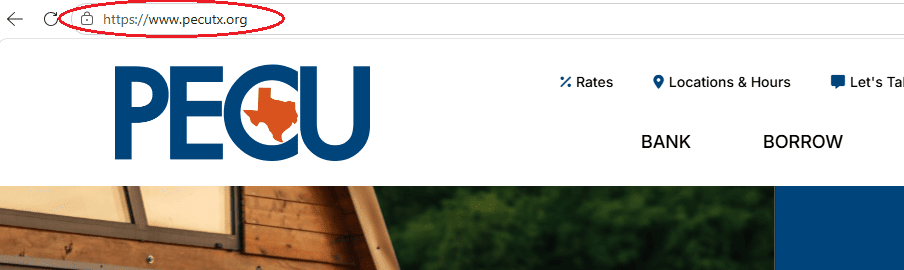
Before entering personal information, verify that the website address ends in pecutx.org and that the browser shows a lock or security icon near the address bar.
PECU Online Banking
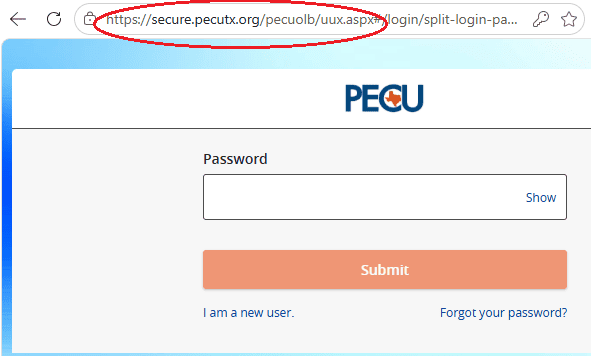
When logging in to Online Banking, confirm the address begins with https://secure.pecutx.org. Do not enter your username or password if the address looks misspelled, unfamiliar, or was opened from a suspicious text or email link.
Four simple rules that stop most scams
- Slow down. Scammers create panic. Real security gives you time to verify.
- Never share codes. A one-time code is like a temporary key to your account.
- Call PECU directly. Do not use a phone number from a suspicious text or email.
- Do not move money for “safety.” PECU will not tell you to buy gift cards, send crypto, or move money to protect your account.
Protect yourself before a scam happens
A few simple habits can make it much harder for scammers to access your account.
Use a strong, unique password
Your PECU password should not be used anywhere else. Longer is better. A password manager can help you create and remember strong passwords.
Turn on account alerts
Alerts can help you spot unusual activity quickly. Review card transactions, transfers, contact changes, and login activity when alerts are available.
Keep your phone and computer updated
Updates fix security problems. Turn on automatic updates for your phone, computer, browser, and apps.
Be careful on public Wi-Fi
Avoid online banking on public Wi-Fi you do not trust. Use your mobile data connection or the PECU mobile app when possible.
Protect your mail and documents
Shred papers with account numbers, Social Security numbers, or other private information. Pick up mail promptly and consider electronic statements.
Talk to family members
Children, older adults, and busy households are common targets. Make a family rule: no urgent money movement without calling a trusted person first.
Common scams to watch for
Fake PECU text messages
A scam text may say your card was used, your account is locked, or you need to verify your information. Do not click the link. Do not reply. Call PECU directly.
Fake text message example
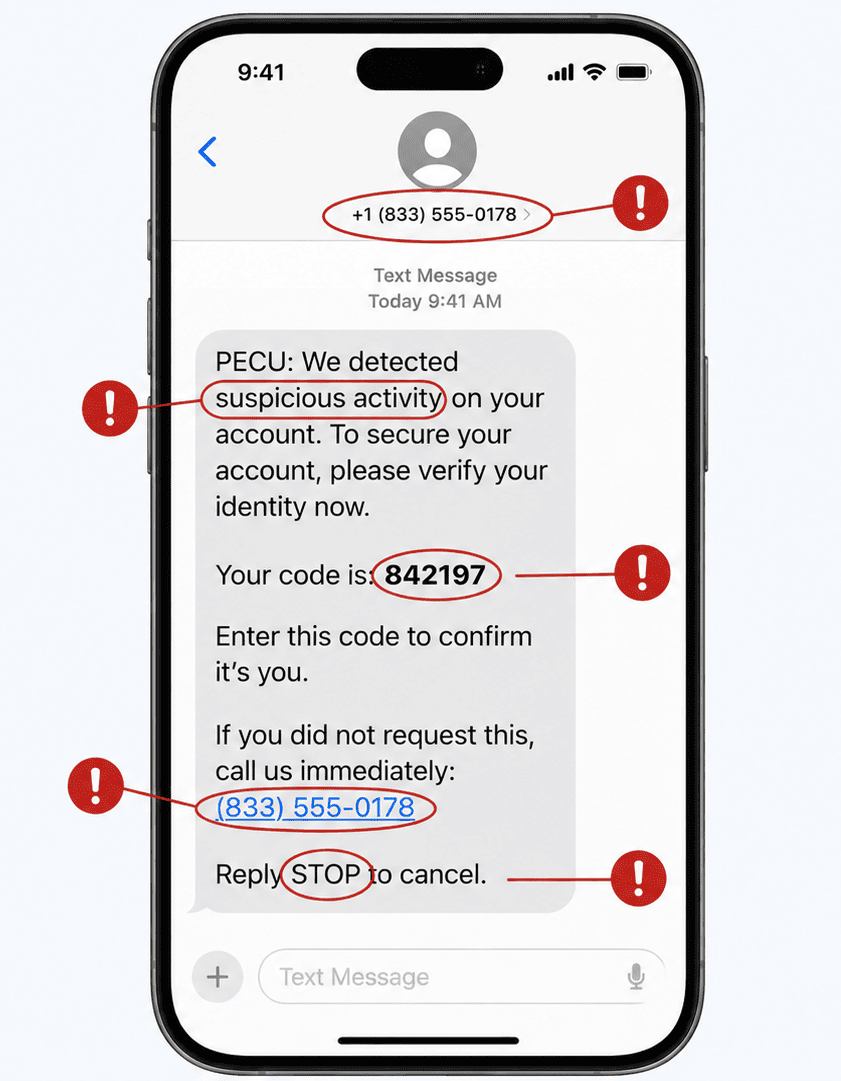
Red flags include urgent language, an unexpected code, an unfamiliar phone number, or instructions to reply. When in doubt, do not respond. Call PECU directly.
Phone calls that spoof PECU’s number
Caller ID can be faked. A scammer can make a call look like it is coming from PECU. If the caller asks for private information, pressures you, or tells you not to hang up, end the call and call PECU directly.
One-time passcode scams
Scammers may ask for the code sent to your phone or email. Never share that code. A one-time code can let someone log in as you.
Fake check and accidental deposit scams
A scammer may send you a check, overpay you, or claim money was sent by mistake. Even if funds appear in your account, the check can still turn out to be fake later. Do not send money back to someone you do not know and trust.
Gift card, crypto, wire, and payment app scams
If someone says you must buy gift cards, send cryptocurrency, wire money, or use a payment app to solve a problem, it is almost always a scam. Gift cards are for gifts, not payments.
If you clicked, paid, or shared information
Do not be embarrassed. Scammers are professionals. The faster you act, the better chance there is to protect your account.
- Call PECU immediately. Tell us what happened and what information was shared.
- Change your online banking password. Use the official PECU website or app.
- Check your accounts. Review recent transactions, transfers, card activity, contact information, and alerts.
- Secure your device. If you installed software or gave remote access, disconnect from the internet and get help.
- Report the scam. Reports help law enforcement and consumer protection agencies warn others.